
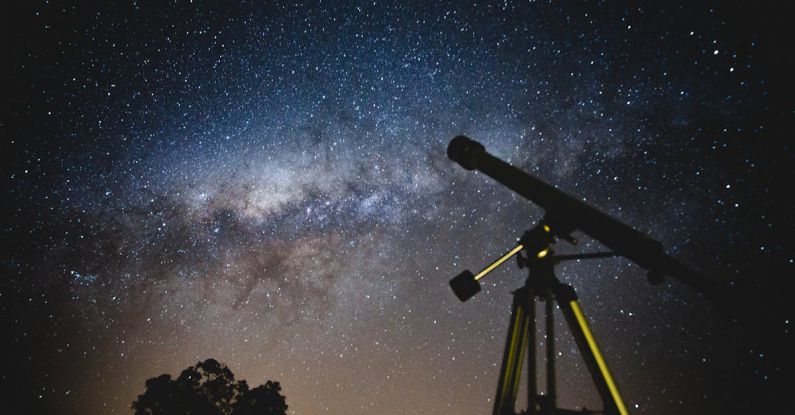
Since the dawn of civilization, humans have gazed up at the night sky in wonder and curiosity. Over the centuries, astronomers have made remarkable discoveries that have expanded our understanding of the universe and our place within it. From the observation of celestial bodies to the exploration of the cosmos, the field of astronomy has continuously pushed the boundaries of human knowledge. In this article, we will delve into some of the most important discoveries in astronomy that have shaped our understanding of the universe.
### Hubble’s Law and the Expanding Universe
One of the most groundbreaking discoveries in astronomy came in the early 20th century when astronomer Edwin Hubble observed that galaxies are moving away from each other at a rate proportional to their distance. This observation, known as Hubble’s Law, provided strong evidence for the expansion of the universe. The implications of this discovery revolutionized our understanding of the cosmos, leading to the development of the Big Bang theory, which posits that the universe originated from a single point and has been expanding ever since.
### Cosmic Microwave Background Radiation
In 1964, astronomers Arno Penzias and Robert Wilson made a serendipitous discovery while working with a radio antenna: they detected a faint background radiation coming from all directions in the universe. This radiation, known as the cosmic microwave background (CMB) radiation, is considered to be the afterglow of the Big Bang and provides crucial evidence for the Big Bang theory. The CMB radiation has been instrumental in shaping our understanding of the early universe and the formation of galaxies and stars.
### Exoplanets and the Search for Habitable Worlds
In recent decades, the discovery of exoplanets—planets orbiting stars outside our solar system—has captured the imagination of astronomers and the public alike. The detection of thousands of exoplanets has revolutionized our understanding of planetary systems and the prevalence of planets in the universe. Of particular interest are exoplanets located within the “habitable zone” of their host stars, where conditions may be suitable for the existence of liquid water and potentially life. The search for habitable exoplanets represents a significant milestone in the quest to find extraterrestrial life.
### Dark Matter and Dark Energy
Despite comprising the vast majority of the universe’s mass-energy content, dark matter and dark energy remain two of the most mysterious and enigmatic components of the cosmos. Dark matter, which does not interact with light and ordinary matter, exerts gravitational forces that influence the motion of galaxies and galaxy clusters. Dark energy, on the other hand, is believed to be responsible for the accelerated expansion of the universe. The discovery of dark matter and dark energy has profound implications for our understanding of the universe’s composition and evolution.
### Gravitational Waves and Black Holes
In 2015, the Laser Interferometer Gravitational-Wave Observatory (LIGO) made history by detecting gravitational waves for the first time. These ripples in spacetime are produced by violent cosmic events, such as the merging of black holes or neutron stars. Gravitational wave astronomy has opened a new window into the universe, allowing astronomers to study phenomena that were previously inaccessible. The detection of gravitational waves has provided direct evidence for the existence of black holes and has offered insights into the nature of gravity itself.
### Conclusion: Unveiling the Mysteries of the Universe
The field of astronomy continues to push the boundaries of human knowledge, revealing the wonders and complexities of the universe. From the expansion of the cosmos to the search for habitable worlds and the discovery of dark matter and black holes, astronomers have made significant strides in unraveling the mysteries of the cosmos. Each new discovery brings us closer to understanding our place in the vast expanse of space and time, sparking further questions and inspiring future generations of explorers to delve deeper into the unknown realms of the universe.